
The "Stanford Method" Illusion: When Multi-Agent RAG Multiplies the Bias
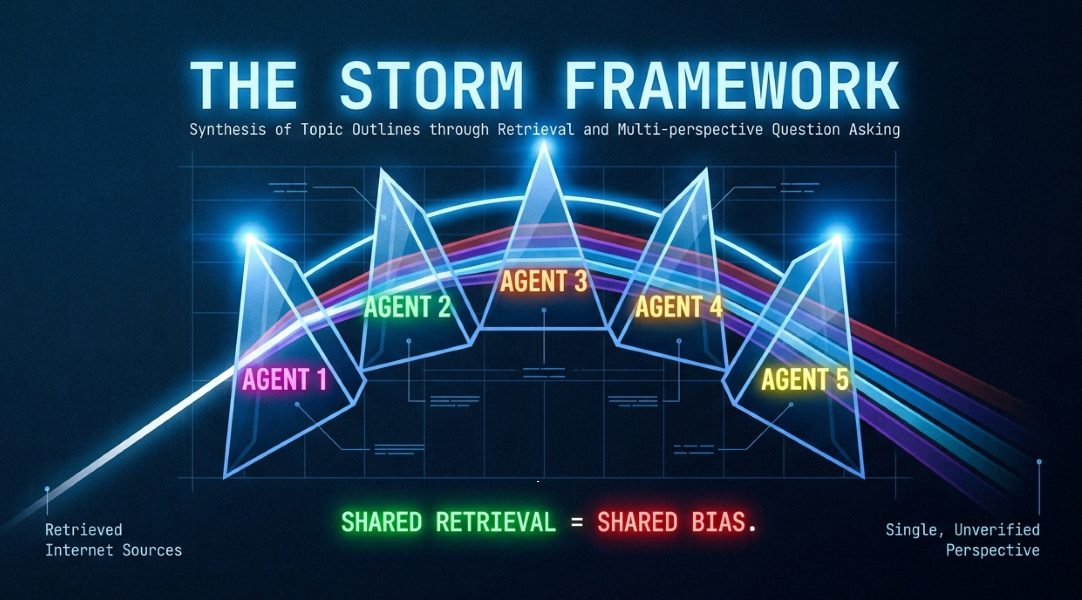
I saw a reel this week claiming a "Stanford Research Method" turns any chatbot into a PhD student, five expert perspectives in five minutes, work that would supposedly take a human forty to sixty hours. I do this for a living: I read papers, then I try to find where they break. So instead of screenshotting the reel and moving on, I went and read the paper it's based on.
It's real. It's called STORM, out of Stanford's OVAL lab, published at NAACL 2024. And it's a genuinely useful piece of research. It's just not the thing the reel is selling you. The gap between what STORM actually does and what got repackaged for an audio hook is worth walking through, because the part everyone skips is the part that matters if you're using this for real research instead of a LinkedIn post.
What STORM is
STORM stands for Synthesis of Topic Outlines through Retrieval and Multi-perspective Question Asking. Shao, Jiang, Kanell, Xu, Khattab, and Lam built it to solve one specific problem: getting an LLM to write a long, well-organized article from scratch, the way a Wikipedia contributor would, when there's no existing outline to work from.
The system runs in two stages. First, it figures out what angles matter for a topic by pulling related Wikipedia articles and extracting the perspectives their authors used. Then it simulates a conversation: a set of LLM personas, each holding one of those perspectives, interview a second LLM that's grounded in live web search results, the way a journalist interviews a source. Each persona asks the questions someone with that specific vantage point would ask. The transcripts from all those simulated interviews get folded into an outline. Only after the outline is stable does the system write the full article, with citations, section by section.
That's it. That's the whole trick. It's not "ask the model to role-play five experts." It's a retrieval loop wrapped in a structured interview format, purpose-built to produce a good pre-writing outline before any prose gets generated.
What the paper measured, and what it didn't
The 25% and 10% numbers in the reels are real, they're just not measuring what you'd assume. The Stanford team built a dataset called FreshWiki, recent, high-quality Wikipedia articles, and compared STORM's output against an outline-driven retrieval-augmented baseline, not against a single throwaway prompt. Against that baseline, STORM's articles were rated better organized by 25 percentage points and broader in coverage by 10. That's a real, well-designed result. It says structured multi-perspective retrieval beats a simpler RAG pipeline at producing an outline.
Nowhere in the paper does it claim to replace forty to sixty hours of PhD reading, or that it produces publication-ready research in ninety seconds. The paper is explicit that the output isn't publication-ready and needs real editing. The "PhD student" framing is the reel author's number, not Stanford's.
The part nobody's putting in a reel
Here's what caught my attention. The researchers didn't just run the benchmark, they had experienced Wikipedia editors review the output. And the editors surfaced two specific failure modes worth naming directly: source bias transfer, and over-association of unrelated facts.
Source bias transfer means that if the sources STORM retrieves lean a certain way, the article inherits that lean, and nothing in the pipeline checks for it. Over-association means the system sometimes stitches together facts that were never connected in the source material, because they showed up near each other during retrieval. Both failures sit inside an article that reads as well-organized and confident, because organization was the one thing the system was optimized for.
Both failures sit inside an article that reads as well-organized and confident, because organization was the one thing the system was optimized for.
The Structural Blindspot
Read the pipeline layout inside the Stanford OVAL STORM GitHub Repository: perspective agents ask questions, a grounded expert answers from retrieved sources, and the system trusts every answer enough to fold it into the outline.
The Bug: There is no step where an agent checks whether the expert's answer is consistent with a different framing of the same source material.
The Result: The system was built to discover diverse questions, not to detect a compromised answer.
If that sentence sounds familiar to anyone who's followed my federated learning work, it should. I've spent the last few months on a defense that flags poisoned client updates in federated aggregation. The core flaw I keep running into both in Federated Learning and now here in multi-agent orchestration is identical: detecting a problem and doing something about it are two separate engineering steps, and most systems only build the first one.
According to the official Stanford STORM Research Project, the system discovers five perspectives. However, it doesn't verify any of them against each other. Five confident voices, all fed by the same retrieval step, can easily converge into an article that looks rigorous while being wrong in the same direction, all five times.
Why the reel version leaves this out
I don't think this is malicious, it's just how virality works. "Five perspectives beat one" is a clean, shareable claim. "Five perspectives that share the same retrieval blind spot can all be wrong together, and the paper's own reviewers said so" doesn't fit in fifteen seconds of narration. But it's the more useful sentence if you're actually going to use this method for research that matters.
What I'd do with this
STORM, and the prompt-based versions built off it, are a legitimately good way to generate a starting outline and surface angles you wouldn't have thought to ask about on your own. Use it that way; it's faster than staring at a blank page. What I wouldn't do is treat the output as verified. Check the sources it actually pulled, not just the ones it cites, and separately ask whether disagreement between your five perspectives is genuine or just theater, because agreement caused by a shared blind spot looks identical to agreement caused by the source material actually being solid.
That's the whole difference between a research tool and a research shortcut: one still needs you to check its work, and the honest ones tell you where to look.


